Clinical Experience
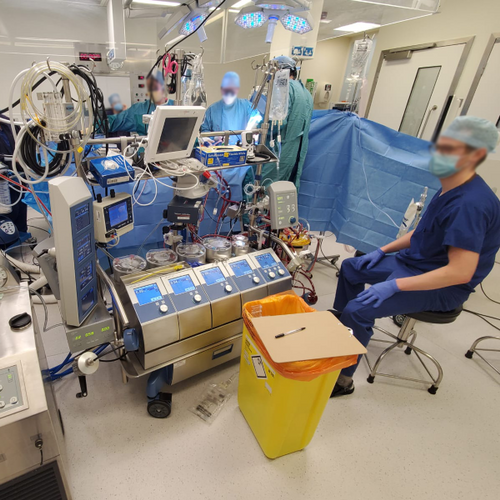
Our team is highly experienced across the full spectrum of adult cardiac surgery. Manchester Royal Infirmary is one of the largest adult cardiac surgical centres in the North West of England, and our perfusionists support approximately 1,000 cardiac operations per year.
This breadth of experience means our team is prepared for every clinical scenario, including high-risk redo surgery, emergency dissection repairs, and advanced mechanical circulatory support.
Procedures We Support
Coronary Artery Bypass Graft (CABG)
The most commonly performed cardiac operation worldwide. CABG uses arteries or veins from elsewhere in the body to bypass blocked coronary arteries, restoring blood flow to the heart muscle. CPB is typically used to provide a still, bloodless field while grafts are sewn. Around 16,000 CABG procedures are performed in the UK each year.
Aortic Valve Replacement (AVR)
Replacement of a diseased aortic valve with a mechanical or biological prosthesis. Aortic stenosis is the most common valvular heart disease in the developed world, particularly in patients over 65. The operation requires CPB and cardioplegic arrest to allow the surgeon to excise the diseased valve and suture the replacement into the aortic annulus.
Mitral Valve Repair / Replacement
Surgery to repair or replace a leaking or stenosed mitral valve. Repair is preferred where possible as it preserves the patient's own valve tissue and has better long-term outcomes. Mitral surgery requires CPB and is technically demanding, often involving annuloplasty rings, chordal repair, or leaflet reconstruction.
Tricuspid Valve Repair
Repair of the tricuspid valve, which sits between the right atrium and right ventricle. Tricuspid regurgitation is often secondary to left-sided valve disease or pulmonary hypertension. Surgery typically involves annuloplasty and is frequently performed alongside mitral or aortic valve procedures.
Aortic Root Replacement
Replacement of the aortic root — the section of the aorta closest to the heart that includes the sinuses of Valsalva and the aortic valve. This complex operation (often a Bentall procedure) uses a composite graft containing a mechanical or biological valve. It is performed for aneurysmal disease, connective tissue disorders (such as Marfan syndrome), and type A aortic dissection.
Atrial Myxoma Excision
Removal of an atrial myxoma — the most common primary cardiac tumour. Myxomas are benign growths that typically arise from the interatrial septum and can obstruct blood flow or embolise. Surgical excision on CPB is curative, with low recurrence rates.
Aortic Dissection / Aneurysm / Trauma
Emergency surgery for type A aortic dissections — a life-threatening condition where the inner layer of the aorta tears, allowing blood to track between the layers of the vessel wall. Without surgery, mortality exceeds 1-2% per hour in the first 48 hours. These operations often require deep hypothermic circulatory arrest (DHCA), where the patient is cooled to 18-20°C and circulation is temporarily stopped to allow repair of the aortic arch. The perfusionist plays a critical role in temperature management and cerebral protection during these cases.
Lung Transplant
Replacement of one or both diseased lungs with donor organs. Lung transplantation is performed for end-stage lung diseases including cystic fibrosis, pulmonary fibrosis, COPD, and pulmonary hypertension. CPB or ECMO support may be required to maintain oxygenation during the procedure, particularly in bilateral transplants. The UK performs approximately 200 lung transplants per year.
PRF — Platelet Rich Fibrin
Preparation of Platelet Rich Fibrin (PRF) from the patient's own blood for use in wound healing and sternal closure. PRF contains concentrated growth factors and fibrin that promote tissue regeneration. The perfusionist prepares this autologous product using centrifugation techniques, and it is applied directly to the surgical wound before closure.
HeartMate / VAD Implantation
Implantation of a Ventricular Assist Device (VAD) — a mechanical pump that supports or replaces the function of a failing ventricle. The HeartMate device is the most widely implanted left ventricular assist device (LVAD) in the world. VADs are used as a bridge to heart transplant, bridge to recovery, or as destination therapy for patients who are not transplant candidates. CPB is required during implantation.
ECMO — Post Cardiotomy / VA-ECMO
Venoarterial ECMO (VA-ECMO) provides temporary mechanical circulatory support when the heart cannot maintain adequate circulation. Post-cardiotomy ECMO is used when a patient cannot be weaned from CPB after cardiac surgery. VA-ECMO drains deoxygenated blood from the venous system, oxygenates it through a membrane oxygenator, and returns it to the arterial system. Our team manages ECMO circuits in both the operating theatre and intensive care unit.
VV-ECMO
Venovenous ECMO (VV-ECMO) provides respiratory support for patients with severe, reversible respiratory failure — such as ARDS (Acute Respiratory Distress Syndrome). Unlike VA-ECMO, VV-ECMO does not provide circulatory support; it drains blood from a large vein, oxygenates it, removes CO₂, and returns it to the venous system. The patient's own heart still pumps blood. VV-ECMO gained widespread recognition during the COVID-19 pandemic as a rescue therapy for patients with severe viral pneumonia.
Adult Congenital Heart Surgery
Surgery for adults with congenital heart defects — structural heart abnormalities present from birth. As paediatric cardiac surgery outcomes have improved, the population of adults living with congenital heart disease has grown significantly. Operations include septal defect closures (ASD/VSD), Fontan revisions, conduit replacements, and redo procedures on previously repaired hearts. These cases often involve complex anatomy and require careful perfusion planning.
TAVI Bypass Cover
Transcatheter Aortic Valve Implantation (TAVI) is a minimally invasive alternative to surgical AVR for high-risk patients. While TAVI does not routinely require CPB, a perfusionist is on standby with a primed bypass circuit in case of life-threatening complications such as aortic rupture, coronary obstruction, or severe haemodynamic collapse that necessitate emergency conversion to open surgery.
Should you require more specific information about any of these procedures or our team's experience, please do not hesitate to contact us.
Contact Us