Cell Salvage
Intraoperative Cell Salvage (ICS) is a technique in which a patient's own blood, lost during surgery, is collected, washed, and returned to the patient as a concentrated red blood cell product. This autologous blood is safe, immediately available, and eliminates many of the risks associated with donor (allogeneic) blood transfusion — including transfusion reactions, disease transmission, and immunosuppression.
MPP can provide the instruments, sterile disposables, and highly trained staff to operate cell salvage equipment across a wide range of surgical disciplines, including: cardiac surgery, vascular surgery, orthopaedics, trauma, obstetrics and maternity, urology, hepatobiliary surgery, and spinal surgery. We operate both elective (planned) and emergency (on-call) cell salvage services.
How Cell Salvage Works
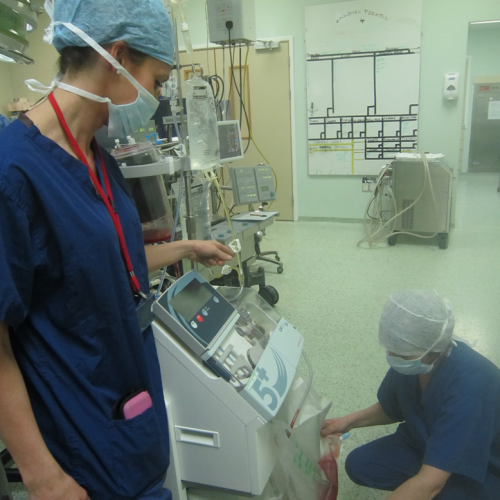
Cell salvage machines — also known as cell savers or autotransfusion devices — work through a process of collection, anticoagulation, centrifugation, washing, and reinfusion. The core components of every cell saver include a suction line (table line), anticoagulant line, collection reservoir, centrifuge bowl, wash solution bag, and waste bag.
During surgery, blood lost in the operative field is suctioned through a double-lumen line. As the blood enters the suction line, it is immediately mixed with an anticoagulant — typically heparinised saline (30,000 IU heparin per litre of 0.9% NaCl) — to prevent clotting. The anticoagulated blood is collected in a filtered reservoir that removes large debris and clots.
Once a sufficient volume has been collected, the blood is transferred to the centrifuge bowl, where it is spun at high speed (typically 5,600 RPM). Centrifugal force separates the blood by density: red blood cells (being heaviest) are packed to the outside of the bowl, while lighter components — plasma, platelets, white blood cells, free haemoglobin, anticoagulant, and surgical contaminants — are displaced to the centre and removed as waste.
The packed red blood cells are then washed with 0.9% normal saline to remove any remaining contaminants, resulting in a final product with a haematocrit of approximately 50-80%. This concentrated, washed red blood cell suspension is collected in a reinfusion bag and can be returned to the patient intravenously. The entire process — from collection to a reinfusion-ready product — can be completed in as little as 3-5 minutes.
Evidence Base & Guidelines
Cell salvage is supported by strong clinical evidence and endorsed by leading UK and international bodies as a core component of Patient Blood Management (PBM). Key recommendations include:
NICE Guidelines
NICE recommends cell salvage as a blood conservation strategy for surgical procedures where significant blood loss is anticipated, including cardiac, orthopaedic, and obstetric surgery (NICE NG24: Blood Transfusion).
Association of Anaesthetists
The Association of Anaesthetists guideline on cell salvage recommends ICS whenever blood loss of 500 ml or more is anticipated, and states it should be considered for all major surgical procedures.
NHS Blood & Transplant
NHSBT and the National Blood Transfusion Committee promote cell salvage as part of their Patient Blood Management strategy — aiming to reduce inappropriate transfusion and the associated ~£170 per unit cost of red blood cells.
Obstetric Use
Cell salvage in obstetrics (particularly caesarean section) is supported by the OAA/AAGBI guideline and has been shown to be safe when used with a leucocyte depletion filter. It is now standard of care in many UK maternity units for high-risk cases.
Advantages of ICS
Cost Comparison
Costs approximate and vary by Trust. Cell salvage also avoids indirect costs: cross-matching, storage, wastage, and transfusion reaction management. Source: NHSBT annual pricing.
Surgical Disciplines Covered
Our Cell Salvage Service
ICS was introduced during the 1980s at the Central Manchester Foundation Trust (CMFT), originally offered during cardiac operations to provide patients with autologous blood and minimise the need for donor transfusions. The service was so successful that today every cardiac operation at Manchester University NHS Foundation Trust is accompanied by ICS.
The demand for ICS across other surgical specialities has grown substantially over the past decade. This growth led to the formation of Haemoclaim Blood Management Service. Haemoclaim now provides ICS across a multitude of disciplines within the Trust — including Obstetrics (caesarean sections and postpartum haemorrhage), Trauma (major trauma activations), Orthopaedics (hip and knee revision surgery, spinal procedures), and Vascular surgery (aortic aneurysm repair, limb revascularisation).
We offer a full 24-hour, 365 days a year on-call service with on-call and standby staff across all MFT sites including St Mary's Hospital. For hospitals outside our contracted Trust, we offer a booking-based elective service for standby and operative cell salvage to NHS trusts and private hospitals across the North West of England.
Haemoclaim Training Course
In addition to providing an ICS service, Haemoclaim has developed a comprehensive, bespoke Cell Salvage Training Course — the only recognised course of its kind in the United Kingdom, accredited by the College of Perfusion Scientists of Great Britain and Ireland. The course equips healthcare professionals (including operating department practitioners, scrub nurses, and theatre staff) with the theoretical knowledge and practical competence to safely set up, operate, and troubleshoot cell salvage equipment.
Course modules cover: the principles of blood conservation and Patient Blood Management, cell salvage machine operation and troubleshooting, anticoagulation management, quality assurance and documentation, clinical governance, and the evidence base for ICS. Practical sessions use simulation equipment to ensure candidates achieve hands-on competence before entering the clinical environment.
Haemoclaim also provides consultancy support for hospitals wishing to establish their own in-house cell salvage service. This includes equipment procurement advice, protocol and SOP development, staff training programmes, clinical governance frameworks, audit templates, and ongoing mentorship during the implementation period.
Interested in our cell salvage service?
Contact us to discuss your requirements or book a cell saver for your hospital.
Get In Touch